c. 966 – 1370

Piast Dynasty

Poland's founding dynasty ruled for over four centuries, from the first forest-clearing settlements to a kingdom stretching across Central Europe. The Piast princes built the foundations of Polish statehood, minted the nation's earliest coins, and left a legacy so enduring that "Piast" became a synonym for native Polish identity.

Map of Poland under Mieszko I, c. 960–992 — the Piast tribal territories at the founding of the Polish state
Poland under Mieszko I, c. 960–992. Wikimedia Commons. Public domain.
Portrait of Mieszko I, Duke of Poland, first ruler of the Piast dynasty
Jan Matejko, Poczet Królów i Książąt Polskich, c.1890–93. Public domain.
c. 960–992 · Duke of Poland

Mieszko I

The father of the Polish state — present at the dawn of its coinage, but his own coins remain unidentified.

Mieszko I was the first historically documented ruler of Poland and the man who put it on the map — literally. His baptism in 966 brought Poland into Latin Christendom, creating diplomatic ties with Rome and the Holy Roman Empire that would define the kingdom for centuries. He unified the Polanian tribes of the Warta River basin, defeated the Veletians, and built a state strong enough to survive his own death.

Whether Mieszko I struck coins is now an open question. The denars long pointed to as his — most famously the MISICO type — have been reattributed by modern numismatic scholarship (Stanisław Suchodolski and others) to his grandson Mieszko II Lambert (r. 1025–1034). The PRINCES POLONIE inscription often cited as early evidence of Polish coinage is now attributed to Bolesław I the Brave, where it gives the first written appearance of the name of Poland on any surviving object. No coin can be securely identified as struck under Mieszko I in current scholarship; the physical coinage of his reign, if it existed, has yet to be recognized. He is preserved here for the founding-of-Poland narrative — the political and religious environment his court created is the soil in which the next generation's coinage took root.

Portrait of Bolesław I the Brave, first King of Poland
Jan Matejko, Poczet Królów i Książąt Polskich, c.1890–93. Public domain.
992–1025 · King of Poland

Bolesław I the Brave

First king of Poland — and the first Polish ruler whose coinage modern scholarship can confidently identify.

Bolesław I Chrobry was Poland's first crowned king, receiving his royal title from Pope John XIX in 1025 — just months before his death. In the decades before that coronation he had already built the most powerful state in Central Europe: he conquered Moravia, Lusatia, and parts of modern Ukraine, and briefly occupied Kyiv. His 1000 AD meeting with Emperor Otto III at Gniezno, where the emperor reportedly placed his own diadem on Bolesław's head, became the founding legend of Polish royal dignity.

Bolesław I the Brave is the earliest Polish ruler whose coinage is securely identified by modern scholarship. His silver denars carry inscriptions including BOLEZLAV in various spellings and, most famously, the legend PRINCES POLONIE — the first written appearance of the name of Poland on any surviving object, predating even the earliest chronicles. The designs include cross, bust, and horseman motifs; the mounted warrior on the reverse foreshadows the armed-knight imagery that would define Polish coinage for centuries. His coins circulated widely and remain key rarities that collectors pursue at auction houses from Warsaw to Basel. (Denars formerly attributed to his father Mieszko I have been reassigned to other rulers by modern scholarship — Bolesław's are the earliest securely Polish coins.)

Portrait of Mieszko II Lambert, King of Poland
Jan Matejko, Poczet Królów i Książąt Polskich, c.1890–93. Public domain.
1025–1034 · King of Poland

Mieszko II Lambert

The grandson to whom the MISICO denars were reassigned — and the king who lost the kingdom anyway.

Mieszko II inherited the mightiest Polish state in history and promptly lost most of it. Dynastic squabbles with his brothers, a pagan revolt that destroyed churches and monasteries, and military pressure from Bohemia and the Rus' stripped Poland of its external conquests. He was stripped of his royal title and spent years in exile before reclaiming a diminished throne. Historians note he faced near-impossible odds. To his credit, Mieszko II was one of the most learned rulers in Europe of his era — fluent in Latin and reportedly in Greek as well, a rarity in early medieval kingship — and he held the Piast heartland together long enough to pass a functioning, if diminished, kingdom to his son Casimir the Restorer.

Modern numismatic scholarship — most notably Stanisław Suchodolski's research — has reassigned the MISICO and MIDICO denar types, long thought to be Mieszko I's, to Mieszko II Lambert. These coins pair the ruler's name with cross, bust, and temple iconography; dies often show wear or misalignment reflecting a kingdom under military and political stress. Mieszko II inherited and continued the minting tradition established by his father Bolesław Chrobry, but the surviving issues of his reign are rare and historically central — any Mieszko II denar at auction is a serious find, typically attracting specialist bidders from both Polish and German numismatic communities.

Portrait of Casimir I the Restorer, Duke of Poland — drawing by Jan Matejko from the Poczet Królów i Książąt Polskich series
Casimir I the Restorer. Jan Matejko, Poczet Królów i Książąt Polskich, c. 1890–93. Public domain.
1034–1058 (in exile 1034–1039) · Duke of Poland (Princeps Poloniae)

Casimir I the Restorer

He returned to a ruined Poland and rebuilt it — earning the name Odnowiciel, the Restorer.

Casimir I came of age in 1034 (he was eighteen) amid the collapse of the Polish state his grandfather Bolesław I had built. A pagan reaction tore through the country, churches were burned, the Bohemian duke Břetislav I sacked Gniezno and carried off the relics of St. Adalbert, and the Piast dynasty itself nearly ended. Casimir fled into exile, likely with his mother Richeza in the Holy Roman Empire. He returned around 1039 with imperial backing and a small force, and over the next two decades restored Poland's territory, rebuilt the Church hierarchy, and shifted the political center from devastated Gniezno to Kraków, which would remain the royal capital for the next five centuries. Polish historians gave him the byname 'Odnowiciel' — the Restorer — for re-founding what had been almost completely lost.

Casimir's silver denars are scarce but historically pivotal — they are the first Polish coins struck after the collapse of Mieszko II's reign and represent the resumption of Polish minting after a near-complete pause. They follow the German imperial denar standard of his era and bear simple legends with crosses, busts, or temple/church imagery. Kraków was the principal mint under Casimir, marking the beginning of that city's centuries-long primacy in Polish coinage. Specimens survive in small numbers in major museum collections (National Museum in Kraków, National Museum in Warsaw) and appear at specialist auctions only rarely.

Portrait of Bolesław II the Bold, King of Poland
Jan Matejko, Poczet Królów i Książąt Polskich, c.1890–93. Public domain.
1058–1079 · King of Poland

Bolesław II the Bold

Restored the crown — then threw it all away.

Bolesław II recovered Poland's royal dignity, receiving a papal crown in 1076 in recognition of his support for Gregory VII in the Investiture Controversy. He was a capable and ruthless ruler who re-expanded Polish territory and reasserted independence from the Holy Roman Empire. But in 1079 he ordered the execution of Bishop Stanisław of Kraków — triggering a noble revolt and his forced exile to Hungary, where he died in obscurity. Stanisław was later canonized; Bolesław was not.

The coins of Bolesław II Śmiały mark a new phase of Polish minting. He was the first Polish monarch to mint coinage in volumes great enough to displace foreign issues, opening royal mints at Kraków and Wrocław. Two main denar types are known: a ducal type from before his 1076 coronation, and a royal type after it showing a crowned bust holding a sword — leaving no doubt about his royal status. Legends are in Latin, often with blundered or stylized lettering typical of 11th-century Polish strikes. Late issues are notably low in silver content, signaling the fiscal strain of his reign. The coins are rare but not impossible to find, and the contrast between ducal and royal types makes them a fascinating area for specialists in early Polish numismatics.

Portrait of Władysław I Herman, Duke of Poland
Jan Matejko, Poczet Królów i Książąt Polskich, c.1890–93. Public domain.
1079–1102 · Duke of Poland

Władysław I Herman

Duke, not king — and his coins know the difference.

Władysław I Herman never claimed the royal title his brother Bolesław II had held, content to rule as duke under the shadow of the Holy Roman Empire. He spent much of his reign under the thumb of his palatine Sieciech, a powerful noble who effectively ran the country. His two sons — Zbigniew and Bolesław (the future Krzywousty) — spent their youths fighting each other and their father, setting the template for Piast dynastic conflict. On the positive side, Herman was a prolific patron of the Church: he founded or endowed numerous monasteries and collegiate churches, most notably the canonries of St. Giles, and his long if unspectacular rule gave Poland a generation of internal peace after the upheavals of his brother's exile — a stability that allowed Bolesław Krzywousty to inherit a kingdom capable of expansion.

The most famous coins of Władysław Herman are his denars featuring a crossbow or archer on the reverse — a motif unique in Polish coinage and likely a personal or dynastic symbol. The obverse typically shows a crude bust with ducal title. These crossbow denars are among the most sought-after Piast rarities; their iconography has never been fully explained, and that mystery only adds to their numismatic appeal. A strong example can bring several thousand euros at specialist auction.

Portrait of Bolesław III Wrymouth, Duke of Poland
Jan Matejko, Poczet Królów i Książąt Polskich, c.1890–93. Public domain.
1102–1138 · Duke of Poland

Bolesław III Wrymouth

Conquered Pomerania, wrote a will that fractured Poland for 200 years.

Bolesław III Krzywousty was one of Poland's great warrior-dukes, defeating Emperor Henry V at Hundsfeld (1109) and subduing Pomerania to bring Poland to the Baltic Sea. His chronicler Gallus Anonymus immortalized his campaigns in the first great work of Polish historiography. But his famous Testament of 1138, dividing Poland among his sons, triggered two centuries of fragmentation that nearly destroyed the kingdom before Łokietek pieced it back together.

Bolesław III's coins include some of the most artistically interesting Piast issues. His Sanctus Adalbertus denars depict St. Adalbert — the martyred Bishop of Prague and patron of Gniezno — enthroned or standing beside the kneeling prince, in surprisingly detailed iconography for early 12th-century minting. This type was introduced after 1113 and reads as a public act of penance following the blinding of his half-brother Zbigniew. Earlier in his reign he issued joint denars showing both himself and Zbigniew during their co-rule (1102–1107) — one of the rarest and most historically compelling Polish coin types. The saint-portrait denars are beautiful and relatively available compared to earlier Piast rarities.

Portrait of Władysław II Wygnaniec, Senior Duke of Poland
Jan Matejko, Poczet Królów i Książąt Polskich, c.1890–93. Public domain.
1138–1146 · Senior Duke of Poland

Władysław II — The Exile

His father's will placed him at the top — his brothers' swords threw him out.

Władysław II Wygnaniec was the eldest son of Bolesław III Krzywousty and the first beneficiary of the notorious Testament of 1138, which named him Senior Duke — the theoretical overlord of all his brothers' principalities. It was a title that proved impossible to hold. His brothers resented his authority from the start, and when Władysław attempted to use German and Pomeranian allies to assert genuine control, they united against him. In 1146 the brothers drove him from Poland with the blessing of the Archbishop of Gniezno. He fled to the Holy Roman Empire, lobbied Emperor Conrad III for military support, and died in exile in 1159 — never setting foot in Poland again. His epithet, Wygnaniec, simply means "the Exile."

The coins of Władysław II Wygnaniec are small silver denars struck during his eight-year rule, bearing eagle, cross, and architectural motifs typical of early Piast minting. They are rare and specifically associated with the very first phase of the fragmentation crisis — each one a small silver token of a kingdom already beginning to fracture. Collecting his issues alongside those of the brothers who followed as Senior Dukes makes for one of the most politically charged sets in Polish medieval numismatics: a coin portrait of a dynasty tearing itself apart.

Map showing the division of Poland into hereditary duchies during the Fragmentation Period 1138–1320
Poland's fragmented duchies c.1138–1320. From E.H. Lewinski-Corwin, Political History of Poland , 1917. Public domain.
1138–1320 · Various Dukes

Fragmentation Period — Provincial Dukes

No single king, but coins everywhere — the golden age of regional minting.

Bolesław III's Testament of 1138 divided Poland into hereditary principalities for his sons, triggering nearly two centuries of fragmentation. The office of Senior Duke (seniorate) was supposed to maintain unity, but it was constantly fought over, ignored, and seized by force. No single Piast ruled the whole country until Władysław Łokietek reunified the crown in 1320.

For numismatists, the fragmentation era is a paradise. Dozens of regional mints operated simultaneously across Silesia, Masovia, Kuyavia, Greater Poland, and Lesser Poland. The era birthed the bracteate — a thin, one-sided silver disc struck from a single die onto soft metal, producing coins of extraordinary visual variety. Eagle bracteates, castle bracteates, figure bracteates, and coins bearing Hebrew inscriptions are among the most visually compelling medieval coins in Europe. Each duchy struck its own types, and the sheer number of rulers means the series spans hundreds of distinct issues, from relatively common to spectacularly rare.

Portrait of Bolesław IV the Curly, Senior Duke of Poland
Bolesław IV the Curly. Jan Matejko, Poczet Królów i Książąt Polskich, c.1890–93. Public domain.
1146–1173 · Senior Duke

Bolesław IV the Curly

First to hold the seniorate — and first to show how fragile it was.

Bolesław IV Kędzierzawy was the second Senior Duke under his father's famous testament — and the first to seize the office by force. He assumed Kraków and the seniorate in 1146 after his brother Władysław II was exiled; German intervention followed (King Conrad III invaded on Władysław's behalf, and in 1157 Frederick Barbarossa forced Bolesław's humiliating submission at Krzyszkowo), setting an immediate precedent: the seniorate could be taken by force and external powers would meddle. He ruled for 27 years, a remarkably stable reign by fragmentation-era standards, and established Kraków firmly as the seat of the senior prince.

His coins are notable for their Byzantine and Eastern iconographic influences — unusual for a Polish ruler and likely a deliberate statement of legitimacy at a time when his authority was contested. Hoards found at Głogów and Dąbrowa Górnicza have yielded his coins alongside those of his rivals, giving numismatists vivid snapshots of competitive regional minting. His use of St. Adalbert imagery on coins was a calculated appeal to religious authority to shore up political power.

Portrait of Bolesław I Wysoki (the Tall), Duke of Silesia
Jan Matejko, Poczet Królów i Książąt Polskich, c.1890–93. Public domain.
1163–1201 · Duke of Silesia

Bolesław I — The Tall

Raised in German exile, he returned to found a dynasty that reshaped Silesia for two centuries.

Bolesław I Wysoki was the eldest son of Władysław II Wygnaniec and, like his father, spent his formative years in exile at the court of the Holy Roman Empire. Emperor Frederick Barbarossa eventually restored Silesia to the sons of Wygnaniec in 1163, and Bolesław I established himself at Wrocław, building what became the most powerful of the fragmentation-era duchies. He was deeply shaped by his German upbringing: his court spoke German, German settlers poured into Silesia under his active patronage, and he founded the great Cistercian abbey at Lubiąż, which stands to this day as one of the largest monastery complexes in Central Europe. The Germanization of Silesia that accelerated under his rule would echo through the region's history across seven centuries.

Bolesław I Wysoki's coins — billon deniers struck at Wrocław — are rare artifacts from a pivotal moment in Silesian history, when the duchy was establishing its own distinct identity apart from the fragmented Polish heartland. As the founder of the Silesian Piast line, his pieces hold particular significance for collectors tracing how one branch of the dynasty gradually drifted towards the Holy Roman Empire and eventually away from Poland altogether. His surviving coins are prized finds at specialist auction precisely because they mark the beginning of that long departure.

Portrait of Mieszko III the Old, Duke of Greater Poland and Senior Duke
Mieszko III the Old. Jan Matejko, Poczet Królów i Książąt Polskich, c.1890–93. Public domain.
1173–1202 · Senior Duke (intermittent)

Mieszko III the Old

He debased the coinage, employed Jewish mintmasters, and is possibly the most numismatically fascinating duke of the era.

Mieszko III Stary earned his epithet honestly — he was Senior Duke on and off for nearly thirty years, repeatedly expelled and returning, outliving almost all his rivals and dying in office in 1202 at an age approaching eighty. His most notorious policy was systematic coin debasement: he reduced the silver content of his denars while maintaining face values, effectively taxing his subjects through monetary manipulation. He was expelled from Kraków in 1177 by a noble and clerical revolt against his autocratic rule and revenue policies — debasement among them — that aligned the magnates with his rebellious son Odon.

Mieszko III commissioned a series of bracteates from Jewish moneyers in Greater Poland that carry Hebrew letters — names like MShKO KRL PLSK (Mieszko King of Poland) and various Hebrew given names of moneyers. These coins are among the earliest medieval European Christian-kingdom coinage bearing Hebrew inscriptions and are among the rarest Polish medieval coins in existence. The National Bank of Poland has honored them with modern commemorative issues. He also opened the bracteate era in Polish coinage, with more than fifty bracteate types attributed to his reign across his long and turbulent rule, though some attributions remain debated.

Portrait of Leszek I the White, Duke of Lesser Poland and Senior Duke
Leszek I the White. Jan Matejko, Poczet Królów i Książąt Polskich, c.1890–93. Public domain.
1194–1227 · High Duke

Leszek I the White

Murdered at a peace summit — his death shattered whatever fragile unity remained.

Leszek I Biały was one of the few princes of his era to hold the seniorate with something approaching general recognition. He was Duke of Sandomierz and Lesser Poland, and despite several expulsions from Kraków, remained a dominant figure in Polish politics for three decades. He was generally regarded as one of the more capable princes of his generation — not a great conqueror, but a competent politician who kept the seniorate functioning when it could easily have collapsed entirely.

His death at the Gąsawa council in 1227 is one of medieval Poland's most dramatic political murders. A summit meeting between Polish princes — intended to settle inheritance disputes and address Pomeranian aggression — was attacked in the early morning. Świętopełk II of Pomerania led the raid. Leszek was caught while fleeing; Henry I the Bearded escaped wounded but alive. The assassination was almost certainly ordered to break Piast suzerainty over Pomerania, and it worked. Within years, the principle of seniorate governance effectively collapsed. His coins — bracteates from the Lesser Poland mints — are among the cleaner surviving examples from the fragmentation period.

Portrait of Henry I the Bearded, Duke of Silesia and High Duke of Poland
Henry I the Bearded. Jan Matejko, Poczet Królów i Książąt Polskich, c.1890–93. Public domain.
1201–1238 · Duke of Silesia; High Duke from 1232

Henry I the Bearded

He escaped the Gąsawa massacre wounded — and came closer to reunifying Poland than anyone before Łokietek.

Henryk I Brodaty made Silesia the most powerful and prosperous Polish principality of the thirteenth century. He actively recruited German settlers under the Ostsiedlung policy, improving agriculture, driving urbanization, and developing silver mining — giving Silesia the economic base to produce the best-quality coinage in Poland during this period. He was present at the Gąsawa ambush of 1227 where Leszek the White was killed; Henry was seriously wounded but survived because his knight Peregrinus of Wiesenburg shielded him with his own body. After becoming High Duke in 1232, he was tantalizingly close to reunifying Poland under a single authority when he died in 1238.

His wife, Hedwig of Andechs, was canonized as a saint in 1267 — making Henry one of the rare medieval Polish dukes whose spouse became a Catholic saint — Kinga, wife of Bolesław V, was canonized in 1999. The Cistercian monastery at Trzebnica, which Henry founded at her request in 1202, still stands. Silesian silver mining under Henry and his successors underpinned the region's sophisticated coinage — castle and figure bracteates from Wrocław under his reign are among the finest surviving examples of the form, with unusually detailed die work reflecting the wealth of his duchy.

Henry II the Pious departing from Legnica before the fateful Battle of Legnica in 1241, sketch by Jan Matejko 1866
Henry II the Pious departing from Legnica. Jan Matejko, sketch, 1866. Public domain.
1238–1241 · High Duke of Poland

Henry II the Pious

He assembled the largest Polish army ever seen — and the Mongols destroyed it in a single afternoon.

Henryk II Pobożny inherited his father's consolidated position as High Duke and immediately faced the worst military crisis of medieval Polish history: the Mongol invasion of 1241. He assembled a coalition force estimated at up to 25,000 men — Polish knights from Silesia, Greater Poland and Opole, Moravian contingents, a small detachment of Templar knights, and Bavarian miners from Złotoryja — and met the Mongol army at Legnica on 9 April 1241 on 9 April 1241. The battle lasted only hours. The Mongols deployed a combination of feigned retreat and smoke screen tactics; Henry's cousin Mieszko II the Fat broke formation, and the coalition collapsed. Henry was captured, killed, and beheaded. The Mongols paraded his head on a spear around the walls of Legnica as psychological warfare.

His reign lasted barely three years — too brief for extensive coin production. But his death had catastrophic consequences for Polish numismatic history: the Mongol devastation destroyed the economic infrastructure of southern and central Poland, setting back coinage production by decades. The silver mines of Silesia he had inherited from his father were disrupted; mints fell silent; the prospect of reunification his father had been building toward vanished entirely. Henry's coins are extremely rare precisely because he ruled for so short a time before one of medieval Europe's most legendary military disasters.

Portrait of Bolesław V the Chaste, Duke of Kraków and Lesser Poland
Bolesław V the Chaste. Jan Matejko, Poczet Królów i Książąt Polskich, c.1890–93. Public domain.
1243–1279 · High Duke of Poland

Bolesław V the Chaste

Ruled for 36 years during the bracteate's golden age — and his wife's legend lives on in every Polish salt shaker.

Bolesław V Wstydliwy was the last male heir of the Lesser Poland branch of the Piast dynasty, and he ruled the fragmentation period's longest reign — 36 years as High Duke from Kraków. His epithet "the Chaste" (Wstydliwy) is unusual for the age: Polish tradition holds that he and his wife Kunigunde of Hungary took a vow of celibacy, making theirs one of medieval Europe's odder royal marriages. He died without an heir in 1279, triggering a succession crisis that consumed the next generation of princes. His wife Kunigunde — known in Poland as Saint Kinga (canonized 1999) — became far more famous than he did. Legend says she threw her engagement ring into a Hungarian salt mine before leaving for Poland, and when the Wieliczka salt mine was opened near Kraków, miners found her ring embedded in the first salt block. The Wieliczka mine became one of medieval Europe's most important economic assets.

His 36-year reign represents the zenith of bracteate production in Lesser Poland. Coins from his Kraków and Sandomierz mints show some of the most refined die-cutting of the fragmentation era — particularly his bracteates featuring the Piast eagle in increasingly heraldic form, foreshadowing the eagle designs that Łokietek and Casimir the Great would later use as explicit royal symbols. His are among the most frequently encountered Piast-era bracteates in Polish numismatic collections, with enough variety across his long reign to form a specialized collection in themselves.

Portrait of Leszek II the Black, High Duke of Poland
Leszek II the Black. Jan Matejko, Poczet Królów i Książąt Polskich, c.1890–93. Public domain.
1279–1288 · High Duke of Poland

Leszek II the Black

Dark hair, dark times — the last Kraków duke before the final scramble for reunification began.

Leszek II Czarny inherited Kraków and the seniorate from Bolesław V in 1279, becoming High Duke by virtue of being the most powerful claimant after the last Lesser Poland Piast died without an heir. His nickname — "the Black" — appears first in a fourteenth-century chronicle and almost certainly refers to his dark hair rather than any character trait. He ruled Sieradz, Łęczyca, and Sandomierz in addition to Kraków, making him one of the more territorially significant dukes of the late fragmentation period.

His nine-year reign came at a pivotal moment: the bracteate era was drawing to a close across Central Europe, and the first signs of a move back toward heavier, two-sided coinage were appearing. Leszek's coins from Kraków and Sandomierz represent some of the final major bracteate issues of the region. When he died in 1288, the succession dispute that erupted between Bolesław II of Masovia, Wenceslas II of Bohemia, and eventually Przemysł II set in motion the chain of events that would end the fragmentation period entirely. His death, unheralded and largely forgotten outside specialist circles, was the last pivot before Poland's long road back to a single crown.

Portrait of Henry IV Probus, Duke of Wrocław and Kraków
Henry IV Probus, Duke of Wrocław. Painting by Bartłomiej Strachowski, 18th century. Public domain.
1288–1290 · Duke of Kraków · Duke of Wrocław (1270–1290); Duke of Kraków (1288–1290)

Henry IV Probus

A learned Silesian duke who reached for the Polish crown — and died on the threshold of it.

Henry IV Probus ruled the Duchy of Wrocław from 1270 and was, by the standards of late-13th-century Piast Silesia, a remarkably cosmopolitan ruler — a known patron of poetry, troubadour culture, and learned clerics. After Leszek II the Black's death in 1288 he secured the seat of the Senior Duke at Kraków, marking the first time in nearly a century that a Silesian Piast held the Polish capital. He pursued elevation to the royal title and was reportedly negotiating with the papal curia for a Polish coronation when he died suddenly in June 1290, possibly poisoned, before any crown could be granted. His brief Kraków rule did not produce stable institutions, but it set a precedent that the Silesian line could legitimately claim seniority — a precedent Władysław Łokietek and Casimir III would later draw on as the Polish kingdom was reunified.

Henry IV's coinage is largely from his Wrocław mint and consists of silver bracteates — single-sided thin silver pieces typical of late-13th-century Silesia and the Holy Roman Empire frontier. Several types bear his ducal name and depict mounted knights, eagles, or busts; legends are in abbreviated Latin throughout. His coins are catalogued in the Kopicki and Friedensburg references for Silesian coinage and circulate at specialist European auctions, particularly in Germany and Poland.

Portrait of Przemysł II, Duke of Greater Poland and King of Poland
Przemysł II. Jan Matejko, Poczet Królów i Książąt Polskich, c.1890–93. Public domain.
1290–1296 (Duke; King of Poland from 1295) · King of Poland

Przemysł II

Restored the royal crown after 219 years — and was murdered nine months later.

Przemysł II spent years consolidating Greater Poland and Pomerania before making the boldest move of any Polish duke since Bolesław the Bold: on 26 June 1295, in Gniezno Cathedral, Archbishop Jakub Świnka placed the Polish royal crown on his head. The crown itself had been locked in the Wawel treasury for 219 years — since Bolesław II was exiled in 1079. The ceremony was a profound political statement. Poland was not just a duchy; it was a kingdom again. Przemysł was thirty-seven years old. He had been working toward this moment his entire adult life.

Przemysł II's coins as duke continue the bracteate tradition of his predecessors in Greater Poland — silver issues from Poznań and Gniezno bearing his ducal name and Piast eagle motifs. His coins as king — the first Polish royal coinage in over two centuries — bear the royal eagle in increasingly heraldic form, marking the visual return of the royal eagle to Polish coinage. The royal coin types are spectacularly rare, with only a few documented specimens, and command tens of thousands at auction when they surface. His coronation in 1295 inaugurated a new era of Polish royal numismatics that would shape the next several centuries.

Portrait of Wenceslaus II, King of Bohemia and Poland
Wenceslaus II, King of Bohemia and Poland. Public domain.
1300–1305 · King of Poland · King of Bohemia (1278–1305); King of Poland (1300–1305)

Wenceslaus II of Bohemia

The Bohemian king who united Poland under one crown — and reformed its money in the process.

Wenceslaus II of the House of Přemyslid was already King of Bohemia when, in 1300, he was crowned King of Poland at Gniezno Cathedral, becoming the first ruler since Przemysł II to wear the Polish crown. He had spent the previous decade extending Přemyslid authority across the Polish lands through marriage alliances, vassalage, and military pressure, marrying Elizabeth Richeza of Poland — daughter of Przemysł II — to bind his claim to the senior Piast line. His five-year reign saw the temporary unification of most of fragmented Poland under one crown for the first time in over a century. Wenceslaus II's death in 1305, followed by his son's assassination in 1306, ended Bohemian rule over Poland and reopened the field for the native Piast restoration under Władysław Łokietek.

Wenceslaus II is one of the most consequential figures in Central European numismatic history: in 1300 he reformed Bohemia's currency by introducing the Prague groschen (groschen Pragensis, grosz praski), a heavy silver coin minted at Kutná Hora that quickly became the dominant trading coin across Poland, Bohemia, Hungary, and beyond. The Prague groschen displaced earlier denar and bracteate coinages and circulated in Poland for over a century, well past the end of Přemyslid rule. No distinct Polish-mint coinage from his five-year Polish reign (1300–1305) is securely identified — Polish territories under his rule used the Prague groschen of Kutná Hora as the official royal currency. His Prague groschen are widely available to collectors today and are catalogued in standard Bohemian numismatic references (Smolík, Castelin) and on Numista.

Portrait of Władysław I the Short, King of Poland
Jan Matejko, Poczet Królów i Książąt Polskich, c.1890–93. Public domain.
1296–1333 (King from 1320; first reign 1296–1300) · King of Poland

Władysław I the Short

Short in stature, enormous in legacy — he put Poland back together.

Władysław I Łokietek — "the Elbow-High," a nickname referencing his supposed small stature — spent decades battling Bohemian kings, Teutonic Knights, and his own fractious nobility before finally being crowned King of a reunited Poland in Kraków in 1320 — the first royal coronation ever held at Wawel in Kraków, after Przemysł II's 1295 and Wenceslaus II's 1300 coronations at Gniezno. He died leaving his son Kazimierz a kingdom that was fragile but sovereign.

Łokietek's coins signal a reunified monarchy. His silver denars — issued from 1306 and especially after his 1320 coronation at Wawel — bear the Piast eagle in some of the earliest clearly heraldic coin designs in Polish minting history. The post-coronation denar pairing the royal eagle with a helmet on the reverse marks the first mass coin emission of the restored Polish kingdom and is a beautiful coin, punching far above its face value in historical significance and collector desirability. The introduction of the kwartnik (half-grosz) and the grosz krakowski belongs to his son Casimir III, but Łokietek's reform laid the groundwork by making Prague-groschen-pattern reckoning the official accounting unit.

Portrait of Casimir III the Great, King of Poland
Jan Matejko, Poczet Królów i Książąt Polskich, c.1890–93. Public domain.
1333–1370 · King of Poland

Casimir III the Great

He found Poland built of wood and left it built of stone — and gold.

Kazimierz III Wielki is the only Polish king history has called "the Great," and the title is well earned. He founded the Kraków Academy (later Jagiellonian University), codified Polish law, defended Jewish communities from persecution, and constructed or fortified dozens of castles across the kingdom. He doubled Polish territory through diplomacy rather than warfare, and died without a male heir — ending the Piast dynasty but leaving Poland the most stable it had ever been.

Kazimierz III introduced the grosz krakowski around 1367 — Poland's first major silver coin, modeled on the Prague groschen and carrying the Piast eagle alongside the king's name. The kwartnik (half-grosz) and ćwierćgrosz (quarter-grosz) rounded out the silver system, with a separate kwartnik ruski struck at Lwów for the Ruthenian territories. The famous unique gold florin (c. 1330, National Museum in Kraków) belongs to his father Władysław Łokietek; no gold coinage of Kazimierz III is documented. The grosz krakowski is the keystone of any serious Piast collection and remains actively traded at European numismatic auctions, with fewer than fifty examples known today.

1370 – 1399

Angevin Period & Jadwiga

After Kazimierz the Great died without a male heir, Poland passed to the Angevin dynasty through his nephew Louis I of Hungary. This brief interlude ended with Poland's greatest strategic marriage: Jadwiga wed the Lithuanian Grand Duke Jagiełło, creating a union that would reshape Central European history for the next two centuries.

Map of Poland at the end of the 14th century — the realm at the time of Louis I and Jadwiga
Poland at the end of the 14th century. Wikimedia Commons. Public domain.
Portrait of Louis I of Hungary, King of Poland
Jan Matejko, Poczet Królów i Książąt Polskich, c.1890–93. Public domain.
1370–1382 · King of Poland and Hungary

Louis I of Hungary

King of two kingdoms, rarely seen in either — but his coins were everywhere.

Louis I of Hungary inherited Poland through his mother, Kazimierz the Great's sister, becoming the first non-Piast dynasty to take the throne apart from the brief Přemyslid interlude of 1300–1306. He was a capable ruler by Hungarian standards but treated Poland as a secondary concern, spending most of his time in Buda. To secure noble loyalty he issued the Privilege of Koszyce in 1374, dramatically reducing taxes on the Polish nobility — a concession that empowered the szlachta for centuries.

Louis continued the Polish minting tradition with denars and kwartniki closely modeled on Kazimierz III's issues, but introduced subtle elements of Hungarian heraldic style. Some issues show the Hungarian stripes alongside the Polish eagle, creating a bilingual heraldic statement in miniature. His coins are not dramatically rare but are historically interesting as the bridge between Piast and Jagiellonian Poland — a favorite of type collectors wanting one example from every Polish dynasty.

Portrait of Władysław Opolczyk, Duke of Opole and Viceroy of Poland under Louis I of Hungary
Władysław Opolczyk, Duke of Opole. Effigy from a historical chronicle. Public domain.
1370–1401 · Duke of Opole; Viceroy of Poland under Louis I

Władysław Opolczyk — Duke of Opole

He gave Poland its most sacred icon — and spent the rest of his career switching sides.

Władysław Opolczyk was a cousin of Louis I of Hungary and one of the most politically restless figures of late 14th-century Poland. Louis appointed him viceroy of Greater Poland and Kuyavia, then governor of Galicia and Podolia — positions of enormous power that Opolczyk wielded with ambition and no particular loyalty. He is remembered today for one extraordinary act of piety: in 1382 he founded the monastery of Jasna Góra in Częstochowa, and around 1384 he brought to it a Byzantine icon of the Virgin from his Ruthenian territories. That icon, the Black Madonna, became the most venerated religious object in Polish history — a symbol of national identity that has survived Swedish invasion, Nazi theft, and communist suppression alike. In every other respect, Opolczyk's career was a disaster: his constant shifts between Bohemian, Hungarian, Teutonic Knight, and Jagiellonian patronage stripped him of his territories piece by piece, and he died in 1401 having lost nearly everything he once held.

Opolczyk's coins are a fascinating numismatic footnote to his chaotic career. His Opole denars and the ruthenian denar and 8-denier pieces from his Galician administration are modest copper and silver pieces, historically specific to the Silesian and Lwów regions he governed. The ruthenian denier — issued for circulation in the eastern territories he administered — is a rare coin that surfaces only in specialist collections. His issues span both the Piast and Angevin era databases, exactly reflecting a man who literally bridged two dynasties with one restless and infuriating life.

Portrait of Jadwiga, Queen Regnant of Poland
Jan Matejko, Poczet Królów i Książąt Polskich, c.1890–93. Public domain.
1384–1399 · Queen Regnant of Poland (Rex Poloniae)

Jadwiga of Poland

Not a queen consort — the king. And her coins said so.

Jadwiga is one of the most extraordinary figures in Polish history. Crowned not as "Queen" but as Rex Poloniae — King of Poland — at age 10 or 11, she was a ruler in her own right, not a consort. She negotiated the union with Lithuania that brought the largest country in Europe into the Latin Christian world, personally led a military campaign to recover Galicia from Hungary, and restored Kraków University. Canonized by Pope John Paul II in 1997, she is the patron saint of queens and united Europe. She died at 25.

Jadwiga's coins are among the most historically charged in Polish numismatics. Her denars bear the crowned eagle of Poland — a direct assertion of sovereign authority — and some carry the letters "H" or "IA" (for Hedvigis/Jadwiga), making attribution clear. These coins are genuinely rare and always attract collector interest at auction; they represent a moment when a teenager held together a kingdom through sheer diplomatic and political skill.

1386 – 1572

Jagiellonian Dynasty

The Jagiellonian dynasty transformed Poland from a mid-sized kingdom into the dominant power of Central and Eastern Europe. At its height, Jagiellonian rulers sat on the thrones of Poland, Lithuania, Bohemia, and Hungary simultaneously. The dynasty's 186-year reign coincided with Poland's Renaissance golden age — and a monetary revolution that gave Poland its first modern coinage system.

Map of the Jagiellonian dynasty lands c. 1490 — Poland, Lithuania, Hungary and Bohemia under one dynasty
Jagiellonian dynasty lands, c. 1490. Wikimedia Commons. CC BY 3.0.
Portrait of Władysław II Jagiełło, King of Poland and Grand Duke of Lithuania
Jan Matejko, Poczet Królów i Książąt Polskich, c.1890–93. Public domain.
1386–1434 · King of Poland, Grand Duke of Lithuania

Władysław II Jagiełło

Crushed the Teutonic Knights at Grunwald — and minted coins for 48 years.

Władysław II Jagiełło founded the Jagiellonian dynasty through his marriage to Jadwiga in 1386, converting from paganism and bringing Lithuania — then the largest state in Europe — into the Polish sphere. His military legacy is defined by the Battle of Grunwald (1410), where a combined Polish-Lithuanian-Ruthenian army shattered the Teutonic Knights. He reigned for 48 years, dying at around 80, and is one of the defining figures of Polish national identity.

Jagiełło reorganized Polish coinage around a new base unit: the półgrosz (half-grosz), introduced in his 1393 reform and originally called the "large kwartnik." He discontinued the full grosz krakowski of Kazimierz III and built a comprehensive system of półgrosze, small kwartniks (trzeciaks), and denars that circulated from the Baltic to the Carpathians. His półgrosz is the most common surviving Jagiellonian coin — practical, beautifully struck, and widely available to collectors today. The variety of mint marks and die combinations across his long reign has produced a rich specialist literature and dozens of distinct catalogued types.

Portrait of Władysław III of Varna, King of Poland
Jan Matejko, Poczet Królów i Książąt Polskich, c.1890–93. Public domain.
1434–1444 · King of Poland and Hungary

Władysław III of Varna

Died at 20 at the Battle of Varna — and his coins nearly vanished with him.

Władysław III became King of Poland at age 10 and King of Hungary at 16, taking on the crusade against the Ottoman Turks that the great powers of Europe demanded. He led a Christian army into Bulgaria and was killed at the Battle of Varna in 1444, aged just 20. His body was never recovered, and persistent survival rumors circulated for years; one Ottoman tradition holds that his head was displayed in Bursa as a war trophy. His death earned him the posthumous title "of Varna" in recognition of his sacrifice. For all the tragedy of his end, Władysław III demonstrated genuine statesmanship in personally uniting the Polish and Hungarian crowns and leading a multinational Christian coalition — a diplomatic and military feat no other Jagiellonian managed — and his willingness to die for his cause made him a symbol of Polish chivalric idealism for centuries.

Władysław III's coins are rare by necessity — his reign lasted only a decade, with years consumed by Hungarian politics and crusading campaigns. His coins continue the Jagiellonian half-grosz tradition but are significantly scarcer than those of his father or successors. Any Polish collection attempting full Jagiellonian coverage will find Władysław III of Varna the hardest piece to source — infrequently offered, and always worth a premium over catalog value.

Portrait of Casimir IV Jagiellon, King of Poland
Jan Matejko, Poczet Królów i Książąt Polskich, c.1890–93. Public domain.
1447–1492 · King of Poland, Grand Duke of Lithuania

Casimir IV Jagiellon

Defeated the Teutonic Order and gave Poland access to the sea — and new coins.

Casimir IV Jagiellon's 45-year reign was one of sustained Polish expansion. His Thirteen Years' War against the Teutonic Order ended in the Peace of Toruń (1466), by which Poland recovered Pomerelia, Gdańsk, and the Vistula delta — giving the kingdom direct access to Baltic trade for the first time since 1308. He placed his sons on the thrones of Bohemia and Hungary, transforming the Jagiellonians into a Central European superpower. He fathered 13 children, including a future saint (Casimir).

Casimir IV undertook significant monetary reform, standardizing the half-grosz coinage and introducing new denar types across multiple denominations. Gdańsk, Toruń, and Elbląg all gained minting privileges after the Teutonic War. The variety of mint marks across his issues makes collecting Casimir IV coins a deep pursuit — specialists catalogue dozens of subtypes, and the Gdańsk issues in particular are prized for their fine engraving.

Portrait of John I Albert, King of Poland
Jan Matejko, Poczet Królów i Książąt Polskich, c.1890–93. Public domain.
1492–1501 · King of Poland

John I Albert

Under Jan Olbracht, the nobility ate the king — but the coins survived.

Jan I Olbracht's reign is remembered above all for the disastrous Moldavian campaign of 1497, where a Polish army was ambushed in the Bukovina forest, earning the proverb "Pod królem Olbrachtem wyginęła szlachta" ("Under King Olbracht, the nobility perished"). He also signed the Privilege of Piotrków (1496), which bound peasants to the land — consolidating the power of the szlachta at the expense of every other class. To his credit, Olbracht was an active patron of the arts and early printing in Poland, and he worked to regularize the operations of the Sejm, helping to formalize the bicameral parliamentary structure that would give Poland one of the most distinctive constitutional systems in Europe.

Jan Olbracht's coins maintain the established Jagiellonian half-grosz tradition with clean, competent engraving. His reign was short enough that his issues are considerably scarcer than those of his father or successor Zygmunt I. The coins mark the stylistic evolution toward Renaissance portraiture that would flower under Zygmunt I — bust types become more naturalistic, lettering more refined. A fine Jan Olbracht half-grosz is a satisfying piece for a type collection and not impossible to find.

Portrait of Alexander Jagiellon, King of Poland
Jan Matejko, Poczet Królów i Książąt Polskich, c.1890–93. Public domain.
1501–1506 · King of Poland, Grand Duke of Lithuania

Alexander Jagiellon

A five-year reign, a permanent political concession — and beautifully scarce coins.

Aleksander Jagiellończyk succeeded to the Polish throne after Jan Olbracht's death, already serving as Grand Duke of Lithuania. His brief reign is most significant for the Constitution of Nihil Novi (1505), which decreed that no new laws could be passed without the consent of both the Senate and the Chamber of Deputies — establishing Poland as a constitutional monarchy at the very moment the rest of Europe was consolidating royal absolutism.

Alexander's coins are the scarcest of the "standard" Jagiellonian half-grosz series simply because his reign lasted only five years. His issues are stylistically similar to Jan Olbracht's but can be distinguished by different bust types and mint marks. A collector completing a Jagiellonian set will find Aleksander the hardest piece to source at auction — not impossibly rare, but infrequently offered, always commanding a premium.

Portrait of Sigismund I the Old, King of Poland
Jan Matejko, Poczet Królów i Książąt Polskich, c.1890–93. Public domain.
1506–1548 · King of Poland, Grand Duke of Lithuania

Sigismund I the Old

Renaissance king, monetary reformer — he gave Poland the złoty.

Zygmunt I Stary presided over Poland's Renaissance golden age. He rebuilt Wawel Castle in Italian Renaissance style, brought humanist scholars and artists to Kraków, and his court became the most culturally sophisticated in Central Europe. His Italian wife Bona Sforza introduced Renaissance customs and architecture. He fought wars on multiple fronts — against Muscovy, the Teutonic Knights, and the Ottomans — with mixed results but kept the kingdom intact for 42 years.

Zygmunt I's monetary reform of 1526–1528 was one of the most consequential events in Polish economic history. He standardized the coinage system around the grosz and introduced the trojak (3 grosz) and szóstak (6 grosz), both first struck in 1528 at Kraków following the Piotrków sejm ordinance. His coins are the first Polish issues to regularly feature a Renaissance-style royal portrait in profile. The grosz, szóstak, and gold ducat of Zygmunt I Stary are cornerstones of any serious Polish collection, ranging from widely available to spectacularly rare.

Portrait of Sigismund II Augustus, King of Poland, engraving c. 1560–1565
Anonymous engraving, c. 1560–1565. Public domain.
1548–1572 · King of Poland, Grand Duke of Lithuania

Sigismund II Augustus

The last Jagiellon — and the one who made Polish coinage truly magnificent.

Zygmunt II August was the last of the Jagiellons, and his death without an heir ended the dynasty that had defined Poland for nearly two centuries. He signed the Union of Lublin in 1569, formally merging Poland and Lithuania into the Polish-Lithuanian Commonwealth — one of the largest states in European history. He was a patron of the arts, famous for his extraordinary tapestry collection at Wawel (still there today), and a man whose three marriages produced no surviving children.

Zygmunt II August's coinage represents the high-water mark of Jagiellonian minting artistry. His silver talers are among the finest portrait coins of 16th-century Europe — large, heavy, magnificently engraved, with a realistic Renaissance portrait on the obverse and the crowned Polish eagle on the reverse. He also issued the trojak (3 grosz), szóstak (6 grosz), and a famous series of Lithuanian coinage in Wilno. The "Augustus" taler is a bucket-list coin for Polish collectors, often fetching five figures at auction in high grades.

1569 – 1795

Polish-Lithuanian Commonwealth

The Polish-Lithuanian Commonwealth was one of the largest and most unusual states in European history — a republic of nobles that elected its kings, guaranteed religious toleration when the rest of Europe was burning heretics, and produced both military glory and spectacular monetary chaos. Its coinage tells the whole story: from the Renaissance perfection of Stefan Batory's talers to the debased copper emergency coins of Jan Kazimierz.

Polish-Lithuanian Commonwealth at its maximum territorial extent — the vast multi-ethnic republic of the early 17th century
Polish-Lithuanian Commonwealth at maximum extent. Wikimedia Commons. CC BY-SA 3.0.
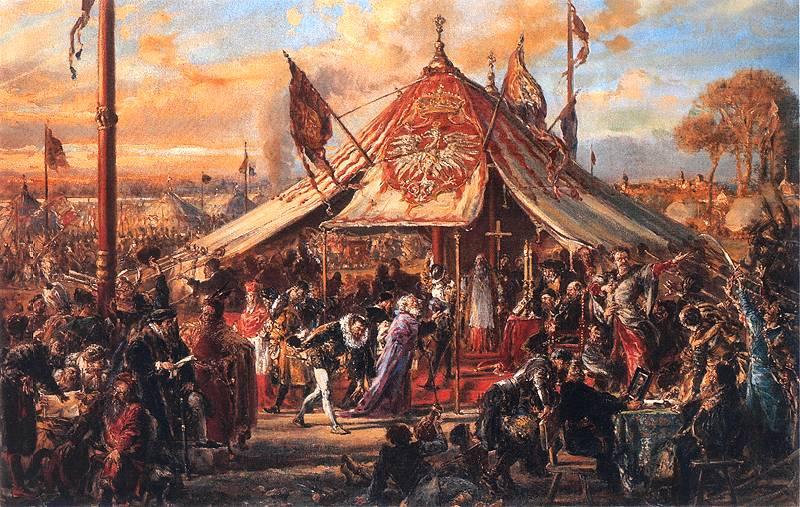
Jan Matejko, Złota Wolność — Elekcja R.P. 1573 (Golden Liberty — Election of the Republic, 1573). The first free election of a Polish king, held during the 1572–1573 interregnum following the death of Sigismund II Augustus.
Jan Matejko, Złota Wolność — Elekcja R.P. 1573 (Golden Liberty — Election of the Republic, 1573), 1889. Royal Castle, Warsaw. Public domain.
1572–1573 · No reigning monarch

Interregnum — The Vacant Throne

The death of the last Jagiellon left Poland without a king for over a year — yet coins were still struck.

When Sigismund II Augustus died on July 7, 1572, he left no heir and no successor. The Jagiellonian dynasty — which had ruled Poland and Lithuania for nearly two centuries — died with him. Under the Polish constitutional system, the death of a king triggered an interregnum governed by the Primate of Poland (Jakub Uchański), who served as interrex and convened the nobility for a royal election. It was the first full free election of a Polish king, and it took more than a year to complete.

During this election period, ordinary commerce did not stop. The Danzig (Gdańsk) mint — one of the most active mints in the Commonwealth — continued striking small silver coinage to meet everyday economic need. In 1573, before the election was resolved, Danzig struck two denominations in its own civic authority: a denar (the smallest silver coin) and a szeląg (schilling). These coins carry no royal portrait and no king's name — only the civic arms of Gdańsk and a date. They are the only Polish coins struck during the interregnum and are collected today as unique numismatic documents of a constitutional moment: a Poland without a king, yet still conducting business.

Portrait of Henry Valois wearing a Polish-style hat, c. 1580
Attributed to François Quesnel, c. 1580–86. Henry depicted in Polish dress. Public domain.
1573–1575 · King of Poland and Grand Duke of Lithuania (also King of France 1574–1589)

Henry III of Valois — The King Who Fled

Elected the first king of the Commonwealth, he swore an oath to Poland, stayed a few months, and slipped away in the night to claim a French crown.

Henry III (French: Henri III, né Alexandre Édouard; Polish: Henryk Walezy; Lithuanian: Henrikas Valua; born 19 September 1551 – died 2 August 1589) was elected King of Poland and Grand Duke of Lithuania in 1573 under the newly formalized elective monarchy that followed the end of the Jagiellonian dynasty. His election was a triumph of French diplomatic ambition — France sought an alliance with the large eastern kingdom to counter Habsburg influence. Henry arrived in Kraków in February 1574, was crowned, and took the oath to uphold the Henrician Articles — the constitutional charter drafted during the preceding interregnum that bound every future Polish king to the nobility's freedoms.

When news reached him in June 1574 that his brother Charles IX of France had died leaving no heir, Henry saw his path to a far more powerful throne. He slipped out of Wawel Castle in the middle of the night on June 18th, 1574, and fled west without formally abdicating. The Polish nobility dispatched riders to recall him; he ignored them. After failing to return, he was formally deposed by the Polish Sejm in 1575. In Poland he is remembered with a mixture of contempt and grudging importance — the man whose constitutional oath gave the Commonwealth its defining legal framework, then abandoned it at the first opportunity.

Portrait of Stefan Batory, King of Poland
Jan Matejko, Poczet Królów i Książąt Polskich, c.1890–93. Public domain.
1576–1586 · King of Poland, Grand Duke of Lithuania

Stephen Báthory

Transylvanian prince, military genius — and the man who reformed Polish money.

Stefan Batory was elected King of Poland in 1576, an outsider candidate from Transylvania chosen partly because he was not too powerful to threaten noble privileges. He proved to be one of the Commonwealth's greatest military kings, defeating Ivan the Terrible in a series of campaigns that recovered Livonia from Muscovite control. His court at Kraków and Grodno was a center of learning and Counter-Reformation Catholicism. He died unexpectedly in 1586, possibly poisoned, leaving no heir.

Stefan Batory overhauled the Polish monetary system with the clarity of his military campaigns. He reorganized the mint network, issued large silver talers with his powerful Transylvanian-Hungarian portrait style, and the Batory taler is among the great pieces of Commonwealth numismatics. His Gdańsk issues are famous for their exceptional engraving quality and are now expensive museum-grade rarities. The triple grosz (trojak) from his reign is also widely collected and far more accessible.

Portrait of Sigismund III Vasa, King of Poland
Jan Matejko, Poczet Królów i Książąt Polskich, c.1890–93. Public domain.
1587–1632 · King of Poland, Grand Duke of Lithuania, King of Sweden

Sigismund III Vasa

45 years on the throne — the most prolific minting reign in Polish history.

Zygmunt III Waza had one of the longest and most consequential reigns in Commonwealth history. A Swedish prince by birth, he claimed the Swedish crown and moved the Polish capital from Kraków to Warsaw — a move the nobility resented but that stuck. He launched a disastrous attempt to place a Catholic king on the Russian throne during the Time of Troubles, occupying Moscow briefly in 1610, and fought constant wars with Sweden and Muscovy, keeping the Commonwealth perpetually mobilized and perpetually in debt. Despite these troubles, Zygmunt III was an accomplished patron of the arts who brought Baroque architecture to Poland and commissioned major building projects in Warsaw and Kraków; his permanent establishment of Warsaw as the capital proved a lasting and strategically sound decision that shaped the geography of the Polish state for the next four centuries.

The sheer volume of Zygmunt III coinage is staggering. He introduced the ort (18 grosz) as a practical denomination and minted extensively at Bydgoszcz, Kraków, Olkusz, and Gdańsk. His portrait style — a distinctive profile with ruffled collar and crown — is immediately recognizable and appears on everything from tiny szeląg coins to spectacular multiple-taler commemoratives. The variety of types, mint marks, and dates makes collecting Zygmunt III an entire hobby in itself.

Arms of the Polish-Lithuanian Commonwealth — used on interregnum thalers struck during the 1632 vacancy between kings
Arms of the Polish-Lithuanian Commonwealth. Public domain.
April–November 1632 · Royal Interregnum

Interregnum 1632 — The Throne Between Kings

Six months without a king — but the Bydgoszcz and Toruń mints kept working, and left behind two remarkable thalers.

When Sigismund III Vasa died on April 30, 1632, the Polish-Lithuanian Commonwealth entered one of its constitutional interregnum periods — the gap between one elected king's death and the next election. The Commonwealth's unusual elective monarchy meant that the throne genuinely was vacant, and elaborate legal arrangements governed how the state functioned during these gaps. The Primate of Poland served as interrex, acting head of state, while the sejm convened to manage affairs and organize the election. The nobility gathered for the elective sejm under "kaptura" — mourning hoods — and conducted business in a kingdom technically without a sovereign. Władysław IV was elected on November 8, 1632, ending a vacancy of just over six months.

The numismatic legacy of the 1632 interregnum is singular and fascinating. The Bydgoszcz and Toruń mints struck special thalers bearing the full arms of the Polish-Lithuanian Commonwealth — the eagle of Poland, the Pahonia of Lithuania — but with no royal portrait, no royal name, and no royal titles. Just the state's heraldry and the year. These "kaptura" thalers are proof minted in silver: the Commonwealth's argument that authority flowed from the state and the szlachta, not from the person of the king. Only two types are recorded, and both are genuine rarities that command serious prices at specialist auction. Finding one is finding a philosophical statement about sovereignty pressed into metal.

Portrait of Władysław IV Vasa, King of Poland
Jan Matejko, Poczet Królów i Książąt Polskich, c.1890–93. Public domain.
1632–1648 · King of Poland, Grand Duke of Lithuania

Władysław IV Vasa

A king who actually liked war — and whose coins reflect a kingdom at its military peak.

Władysław IV Waza was arguably the most capable of the Vasa kings of Poland. He defeated Muscovy in the Smolensk War, forced the Ottomans to renew peace, and pressured a war-weary Sweden into the favorable Truce of Stuhmsdorf — three diplomatic and military successes at the start of his reign, earning genuine military prestige. He was also the last Polish king to make a serious attempt at strengthening royal authority against the nobility, and the first Polish king to have an opera company. His death in 1648, on the eve of the Cossack uprising, triggered the catastrophes of his brother Jan Kazimierz's reign.

Władysław IV's coinage maintains the high quality of the late Zygmunt III issues while introducing a distinctive portrait style that shows more of the king's face than his father's conservative profile. The orty (18 grosz), szóstaki (6 grosz), and talers of Władysław IV are beautiful, well-struck coins that command consistent collector interest, and his gold ducats — issued in multiples up to 8 ducats — are showpieces of the late Vasa portrait style.

Portrait of John II Casimir Vasa, King of Poland
Jan Matejko, Poczet Królów i Książąt Polskich, c.1890–93. Public domain.
1648–1668 · King of Poland, Grand Duke of Lithuania

John II Casimir Vasa

The Deluge, the boratynki, and a kingdom that almost disappeared.

Jan II Kazimierz Waza inherited a kingdom and watched it nearly dissolve. The Swedish invasion known as "the Deluge" (Potop, 1655–1660) left almost every major Polish city occupied, the Wawel treasury looted, and the population reduced by perhaps a third through war, plague, and famine. He is also remembered for the miraculous defense of Jasna Góra monastery at Częstochowa — a turning point that became the founding legend of Polish Marian nationalism. He abdicated in 1668 and retired to a French monastery.

The coinage of Jan Kazimierz's reign is a textbook in monetary crisis. The infamous boratynka — a copper szeląg minted in enormous quantities from 1659 to pay for the Deluge wars — debased Polish currency so severely it circulated at tiny fractions of its nominal value. The tymf (nominally 30 grosz but containing only 15 grosz worth of silver) compounded the crisis. Both coins are widely available today and are fascinating historical artifacts of Poland's worst century — cheap to collect, but loaded with significance.

Portrait of Michael Wiśniowiecki, King of Poland
Jan Matejko, Poczet Królów i Książąt Polskich, c.1890–93. Public domain.
1669–1673 · King of Poland, Grand Duke of Lithuania

Michael Wiśniowiecki

A weak king, a short reign — and some of the scarcest Commonwealth coins.

Michał Korybut Wiśniowiecki was elected King of Poland in 1669 as a compromise candidate acceptable to none of the major noble factions — which more or less describes his entire reign. A gentle, indecisive man of no military talent, he spent four years being outmaneuvered by his own nobility, fighting an unsuccessful war against the Ottoman Turks that cost Poland the fortress of Kamianets-Podilskyi, and dying at 33. The great hetman Jan Sobieski had more real power throughout than the king himself. To his credit, Michał was genuinely and enthusiastically supported by the lesser szlachta — who valued him precisely because he was a native Pole unbeholden to foreign powers or the great magnate families — and he personally marched with the army toward Khotin in 1673, demonstrating real personal courage in attempting to lead Poland's defense against the Ottoman threat even as his health was failing.

The coins of Michał Korybut Wiśniowiecki are the scarcest of the "standard" Commonwealth series. His reign lasted only four years, minting volumes were low due to financial chaos, and his tymf and szeląg are rarely encountered at auction. Any Polish collection attempting full Commonwealth coverage will find Michał Wiśniowiecki the hardest ruler to complete — not impossibly rare, but infrequently offered and always worth a premium.

Portrait of John III Sobieski, King of Poland, hero of the Battle of Vienna
Jan Matejko, Poczet Królów i Książąt Polskich, c.1890–93. Public domain.
1674–1696 · King of Poland, Grand Duke of Lithuania

John III Sobieski

Saved Vienna from the Ottomans in 1683 — the last great Polish king.

Jan III Sobieski is the most celebrated military figure in Polish history. On September 12, 1683, his winged hussars led the largest cavalry charge in recorded history down the Kahlenberg hillside outside Vienna, shattering an Ottoman army that had besieged the city for sixty days. Pope Innocent XI called it "the salvation of Christendom." Sobieski commanded the combined Polish, German, and Austrian relief force as supreme commander — the position was his because no other monarch present had his battlefield authority. Before Vienna made him a legend, he had already routed a larger Ottoman army at Khotyn in 1673, destroying most of the 35,000-strong force under Hüseyin Pasha, a victory so decisive that the Polish nobility elected him king the following year. He spent his reign pushing the Ottoman frontier back, recovering territory lost under his predecessor, rebuilding border defenses, and personally leading every major campaign. Away from the battlefield he rebuilt Wilanów Palace into one of the finest Baroque residences in Northern Europe and maintained one of the most intellectually lively courts of his era. He died in 1696 disappointed — his attempts to secure the throne for his son Jakub were defeated by noble factionalism — but his military legacy was unmatched.

For numismatists, Sobieski's reign is one of the high points of Commonwealth coinage. His gold ducats carry a superbly engraved portrait in full armor — widely considered the finest royal portrait of any Commonwealth ruler — and the commemorative medals struck for the Relief of Vienna in 1683 are among the most historically significant pieces in Polish numismatics, competed for by collectors of Polish, Austrian, and Ottoman history alike. His coinage spans three Polish Crown mints — Bydgoszcz, Kraków, and Gdańsk — giving specialists a rich field of die varieties to pursue. A full Sobieski collection is achievable but demands patience and a serious budget for the gold and commemorative pieces.

Portrait of Augustus II the Strong, King of Poland and Elector of Saxony
Jan Matejko, Poczet Królów i Książąt Polskich, c.1890–93. Public domain.
1697–1704 & 1709–1733 · King of Poland, Elector of Saxony

Augustus II the Strong

Strong enough to bend horseshoes — and to mint on both sides of the border.

Augustus II, Elector of Saxony, converted to Catholicism to win election as King of Poland, uniting the Polish crown with the wealthy Saxon electorate. He is famous for his physical strength, his hundreds of illegitimate children, and his magnificent Dresden court with its world-class porcelain and art collections. In Poland he is remembered less favorably — his reign coincided with the Great Northern War that devastated the country, and the Saxon period is widely seen as the beginning of the end of the Commonwealth.

The coinage of Augustus II is distinctively dual-character: Polish-type issues for the Commonwealth and Saxon-style issues for Germany, sometimes sharing the same mint facilities. His Polish taler carries his unmistakable portrait — a broad, heavy-featured face reflecting the man who could reportedly break horseshoes — along with the combined arms of Poland, Lithuania, and Saxony. The Saxon-type groschen struck for Polish circulation are popular with collectors of both German and Polish numismatics.

Portrait of Stanisław Leszczyński, King of Poland and Duke of Lorraine, by Jean Girardet, c. 1750
Jean Girardet, Stanisław Leszczyński, c. 1750. Public domain.
1704–1709 & 1733–1736 · King of Poland (elected twice)

Stanisław Leszczyński — The Twice-Elected King

Twice elected King of Poland, twice deposed by foreign armies — and the only modern Polish king who never struck a single coin.

Stanisław Leszczyński's story is one of the most extraordinary in Polish royal history — a man who was elected King of Poland not once but twice, deposed both times by foreign armies, and who nevertheless died celebrated as a model philosopher-king. Born in 1677 into a noble Poznań family, he rose to prominence in the turbulent court politics of the early eighteenth century. In 1704, during the Great Northern War, the Swedish king Charles XII forced a new election in the Commonwealth and backed Leszczyński — then only 26 — over the incumbent Augustus II of Saxony. Leszczyński was elected by a faction of the Polish nobility and ruled from 1704 until Charles XII's catastrophic defeat at the Battle of Poltava in 1709, after which Russian and Saxon forces restored Augustus II and Leszczyński fled into exile in Swedish Pomerania and then Alsace.

His second chance came in 1733 when Augustus II died. Leszczyński was elected by an overwhelming majority of the Polish nobility — some accounts say over 13,000 of the 14,000 assembled electors voted for him. But Russia and Austria refused to accept a French-aligned king (his daughter Marie Leszczyńska had married Louis XV of France in 1725, making him the French king's father-in-law). A Russian army marched into Poland, installed Augustus III of Saxony as a rival claimant, and besieged Leszczyński in Danzig. France, embarrassed by its inability to defend its ally, compensated him: Leszczyński received the Duchy of Lorraine in 1737, which would revert to France on his death. He ruled Lorraine from his court at Lunéville until 1766 — nearly 30 years — and became known as "Stanisław the Beneficent," building hospitals, schools, and the magnificent Place Stanislas in Nancy, now a UNESCO World Heritage Site.

Portrait of Augustus III of Saxony, King of Poland
Jan Matejko, Poczet Królów i Książąt Polskich, c.1890–93. Public domain.
1733–1763 · King of Poland, Elector of Saxony

Augustus III of Saxony

He loved art, opera, and hunting — and left the governing to someone else.

Augustus III inherited his father's twin titles and his taste for luxury without his energy or political skill. He spent most of his reign in Dresden, leaving Poland to be governed by the powerful Czartoryski and Poniatowski families. His 30-year reign was one of near-total political paralysis — the liberum veto was used more extensively than ever before, and the nobility's factionalism paralyzed every attempt at reform. His personal art collection, transferred to Dresden, became the nucleus of what is now the Gemäldegalerie Alte Meister. More significantly for Poland's future, the very vacuum of royal authority during his reign allowed the Czartoryski reform movement — the Familia — to develop and refine the political ideas that would culminate in the Constitution of May 3rd, 1791, making his reign, despite itself, a necessary incubator of Polish Enlightenment thought.

Augustus III's Polish coinage followed the path of least resistance. His issues continued the Saxon-Polish dual-currency tradition established by his father, with groschen, szóstaki, and silver talers carrying his slightly plump portrait. The coins are competently made and widely available, but lack the dynamism of earlier Commonwealth issues. Collectors pursuing the complete Commonwealth series will find Augustus III among the more accessible rulers to fill.

Portrait of Stanisław August Poniatowski, last King of Poland
Jan Matejko, Poczet Królów i Książąt Polskich, c.1890–93. Public domain.
1764–1795 · King of Poland, Grand Duke of Lithuania

Stanisław August Poniatowski

The last king of Poland — and the architect of its finest coinage.

Stanisław August Poniatowski was elected king in 1764 with Russian backing — he had been a lover of Catherine the Great — and spent his 31-year reign trying to reform a state that his sponsors wanted kept weak. He succeeded brilliantly in culture: his Thursday dinners at the Royal Castle became the most important intellectual gathering in Eastern Europe, and he patronized artists and architects who created the last great flowering of Polish Enlightenment culture. He failed politically: the May 3rd Constitution (1791) — the first modern written constitution in Europe and the second in the world — came too late to prevent the three Partitions that erased Poland from the map.

Stanisław August's monetary reform of 1766 created the most rational coinage system Poland had ever had: a structure based on the Cologne grzywna of pure silver yielding 80 złoty, with the złoty divided into 30 copper grosz (or 4 silver groszy), the talar worth 8 złoty (32 silver groszy), and gold ducats at the top. His coins are the most beautiful in Polish history by common consent — elegant neoclassical engraving, the king's portrait modeled on ancient cameos, the Polish eagle redesigned with heraldic precision. The gold 4-ducat piece is a masterwork of 18th-century numismatic art. His last coins were struck in 1795, the year Poland ceased to exist.

1795 – 1918

Partitions Era

From 1795 to 1918 Poland did not exist as an independent state — divided between Russia, Prussia, and Austria. Yet Polish coins continued to be minted under foreign rulers, first in the Duchy of Warsaw under Napoleon's ally Frederick Augustus, then in the Congress Kingdom under the Russian Tsars. Each coin from this era carries the weight of a nation holding on to its identity under occupation.

Map showing the three Partitions of Poland between Russia, Prussia, and Austria, 1772–1795
The three Partitions of Poland, 1772–1795. Wikimedia Commons. Public domain.
Portrait of Maria Theresa, Empress of Austria, who annexed Galicia in the First Partition of Poland, 1772
Maria Theresa. Anton von Maron, c. 1772, Schönbrunn Palace. Public domain.
1772–1780 · Habsburg Empress, ruler of Austrian Galicia

Maria Theresa & Joseph II — Habsburg Galicia

"She wept, she conquered" — and issued the first Habsburg coinage for her new Polish crown-land.

Voltaire wrote the famous summary: "This princess, who wept over the partition, took care always to take her share." When the First Partition of Poland was signed on August 5, 1772, Austria seized the Kingdom of Galicia and Lodomeria — a vast slice of southeastern Poland including Lwów, the Kraków hinterland, and the salt mines of Bochnia and Wieliczka, which alone were worth the price of the whole transaction. Maria Theresa genuinely agonized over the morality of seizing a neighbor's territory; her son Joseph II, co-ruler from 1765, felt no such qualms and pushed hard for expansion. Together they built a new Austrian province from Polish land, introducing German-language administration, Josephine church reforms, and a coin system that married Polish denomination names to Habsburg imagery. Voltaire's wit cut to the heart of it: conscience is a luxury, territory is permanent.

The Galician coinage of Maria Theresa — struck 1774–1777 — consists of three denominations: a copper 1 Schilling (Polish: szeląg) issued only in 1774, and silver 15 Kreuzer and 30 Kreuzer pieces (Polish: krajcarów) struck 1775–1777, all bearing the IC-FA mintmaster initials of the Vienna officials Joseph Ignaz Carl Hoffmann and Franz Anton Schwarzleitner. They are historically precise: the first coins ever minted specifically for the Austrian partition of Poland, issued just two years after the annexation, and the obverse silver pieces carry Maria Theresa's portrait alongside the heraldic arms of the new Kingdom of Galicia and Lodomeria. (Note: the 1, 3, and 6 grossi copper pieces commonly mistaken for Maria Theresa issues are actually 1794 strikes under Francis II for the Imperial Austrian Army during the Kościuszko Uprising — distinct issues from a different ruler entirely.) Collectors of both Habsburg and Polish material seek out the 1774–1777 series, giving these pieces a persistent dual market.

Portrait of Friedrich Wilhelm II, King of Prussia, who acquired Polish territories in the Second and Third Partitions
Friedrich Wilhelm II of Prussia. Anton Graff, 1792. Public domain.
1786–1797 · King of Prussia

Friedrich Wilhelm II — South Prussia

He partitioned Poland twice and spent the profits on his mistress's palace.

Friedrich Wilhelm II inherited Frederick the Great's Prussia in 1786 and promptly demonstrated he was nothing like his uncle. Where Frederick had been austere, intellectually formidable, and relentlessly militaristic, Friedrich Wilhelm II was indolent, dominated by favorites, and given to expensive pleasures. His political legacy, however, was enormous almost by accident: he participated in both the Second Partition of Poland in 1793 — which gave Prussia the Poznań region as "South Prussia" (Südpreußen) — and the Third Partition in 1795, which extinguished Polish statehood entirely. The great port city of Gdańsk, which Frederick the Great had coveted for decades, also finally fell to Prussia in 1793. Friedrich Wilhelm II acquired more Polish territory than any other Prussian king but died in 1797 before seeing Napoleon undo most of those gains just nine years later.

His South Prussian coins — struck 1796–1797 in copper, in the last year of his reign — are the first coins ever minted specifically for the Prussian-administered Polish territories seized in the Second and Third Partitions. The denominations use both German and Polish terminology (Grossus/Groschen, Solid/Szeląg), and some carry distinct "S.PRUSS" legends. These are historically charged objects: small copper coins struck on the ashes of Polish statehood, bearing the Hohenzollern eagle where the Polish eagle had been. They are keenly collected by specialists in Partition-era Polish numismatics.

Portrait of Francis II, Holy Roman Emperor, who issued Galician coins in 1794 and later became Francis I of Austria
Francis II, Holy Roman Emperor. Friedrich von Amerling, c. 1832. Public domain.
1792–1806 · Holy Roman Emperor; 1804–1835 · Emperor of Austria

Francis II — The Last Holy Roman Emperor

He dissolved a thousand-year empire rather than let Napoleon hold the title — and kept minting Polish coins regardless.

Francis II became Holy Roman Emperor in 1792 at the worst possible moment — just as France declared war on Austria and the Revolutionary Wars began their chain of conflicts that would reshape Europe. His armies fought Napoleon repeatedly and lost repeatedly — at Marengo (1800, where his army was led by General Melas), at Austerlitz (1805), and at Wagram (1809). After Austerlitz, Napoleon dissolved the Holy Roman Empire and Francis responded with elegant constitutional theater: he proclaimed himself Francis I, hereditary Emperor of Austria — ensuring that when he surrendered the old imperial crown, he already had a new one. His 1794 Galician coins are stamped in the midst of the Third Partition crisis, the year Kościuszko's national uprising was being crushed and the last pieces of independent Poland were being carved up among the powers.

The Francis II Galician copper coins of 1794 — 1 Grossus, 3 Grossi, 6 Grossi — are a compact and historically charged series. They were struck the same year that Kościuszko's forces were fighting and losing their last battles, and the year Austria expanded its Polish holdings in the Third Partition. Minted in Vienna for circulation in Galicia, they carry the Habsburg eagle and Francis's title as Holy Roman Emperor — a title he would surrender just twelve years later. For collectors, the 1794 date makes these coins vivid witnesses to the final destruction of Polish independence.

Portrait of Friedrich Wilhelm III, King of Prussia, whose reign spanned the Napoleonic era and the Congress of Vienna
Friedrich Wilhelm III of Prussia. Franz Krüger. Public domain.
1797–1840 · King of Prussia

Friedrich Wilhelm III — A Long Reign Across a Broken Map

He lost Polish territories to Napoleon and got most of them back at Vienna — minting coins throughout.

Friedrich Wilhelm III's 43-year reign contained more historical upheaval than most countries experience in a century. He inherited his father's newly acquired Polish territories in 1797, lost most of them when Napoleon crushed Prussia at Jena-Auerstedt in 1806 and reconstituted Polish lands as the Duchy of Warsaw, and then slowly rebuilt through the reform era of Hardenberg and Scharnhorst. At the Congress of Vienna in 1815, Prussia recovered the Grand Duchy of Poznań, and Friedrich Wilhelm III's later coins reflect this stabilized if reduced Polish presence. His reign bracketed the entire Napoleonic period — from the last years of the partitioned order to the new Congress-era arrangement that would hold until 1848. He outlived Napoleon, Wellington, and most of the men who made the world he inherited.

The Friedrich Wilhelm III Prussian-Polish coins span two distinct phases separated by Napoleon's disruption. The pre-Napoleonic issues (1801–1807) carry "S.PREUSS" mint marks and continue his father's partition coinage tradition. The post-Vienna issues (1816–1817) reflect the Grand Duchy of Poznań and include transitional types bridging the Napoleonic gap. Together they form a numismatic biography of Poland's most turbulent quarter-century: modest copper schillings and groschen that changed hands as empires were made and unmade around them.

Portrait of Frederick Augustus I, King of Saxony and Duke of Warsaw
Frederick Augustus I. Anton Graff, c. 1800. Public domain.
1807–1815 · King of Saxony, Duke of Warsaw

Frederick Augustus I — Duchy of Warsaw

Napoleon's Polish client state — and the coins that gave hope a face.

Napoleon's victory over Prussia in 1806–07 created the Duchy of Warsaw from Prussian-held Polish territories, placing Frederick Augustus I, King of Saxony, on its throne. It was a partial resurrection of Poland — limited in territory, dependent on French bayonets — but it gave Poles a national army that fought magnificently across Europe and Polish-language governance for the first time in over a decade. The Duchy dissolved after Napoleon's defeat; the Congress of Vienna reconstituted it as the Congress Kingdom under Russian control in 1815.

The Duchy of Warsaw's coinage was struck at the Warsaw Mint (Mennica Królestwa Polskiego), featuring Frederick Augustus's portrait on the obverse and the Duchy's arms — a combination of the Saxon and Polish devices — on the reverse. These coins are historically poignant objects: each one was struck during a brief window when Polish statehood flickered back to life. They are collected both by Polish numismatists and by Napoleonic-era specialists, generating cross-market demand that keeps prices firm.

Coat of arms of the Free City of Danzig — two white crosses on red, symbol of Gdańsk since the medieval period
Arms of the Free City of Danzig, 1807–1814. Public domain.
1807–1814 · Napoleonic Free City under French and Saxon protection

Free City of Danzig — Gdańsk Under Napoleon

For seven years, Poland's greatest port answered to no one — and minted its own money to prove it.

When Napoleon crushed Prussia at Jena-Auerstedt in October 1806 and the dust settled at Tilsit in July 1807, the old Prussian map of the Baltic coast was swept away. The Treaty of Tilsit created the Duchy of Warsaw from the heart of Prussian Poland, but for Gdańsk — the great commercial port Prussia had seized from Poland in 1793 — Napoleon chose a different arrangement. He declared it a "Free City" under French and Saxon protection, with its own senate, constitution, and garrison of French troops. The city had been a free Hanseatic republic for centuries before the Prussian annexation; the Napoleonic free-city status was in some ways a restoration of that older proud identity, even if the French troops garrisoning the ramparts told a different story.

The Free City of Danzig struck its own coinage: a copper schilling (1808 and 1812) and a copper groschen (1809 and 1812) (four circulating types in total), bearing the distinctive two-cross arms of Gdańsk and the legend FREIE STADT DANZIG. A silver six-groschen (1/5 Gulden) pattern was also prepared in 1808–1809 but never entered circulation. These coins circulated during years when the city was simultaneously a French-allied trading hub, a fortress preparing for eventual siege, and a transit point for troops marching to and from Napoleonic campaigns in the east. When Napoleon's empire collapsed after Moscow, the city fell to Prussian and Russian forces in 1813–14 and reverted to Prussian control. The four circulating coin types are compact historical documents — scarce, specific, and pursued by collectors of both Polish and Napoleonic material.

Portrait of Alexander I, Tsar of Russia and King of Poland
Alexander I, Tsar of Russia. George Dawe, 1826. Public domain.
1815–1825 · Tsar of Russia, King of Poland

Alexander I — Congress Kingdom

Tsar and King at once — the Congress Kingdom's ambiguous opening act.

The Congress of Vienna reconstituted Polish territories as the Congress Kingdom of Poland, constitutionally linked to the Russian Empire with Tsar Alexander I as its king. Alexander was a complex figure — a liberal in his youth who had flirted with Polish hopes of full independence, then a reactionary who crushed reformers. The Congress Kingdom had its own parliament, army, and currency in the early years, seeming to offer genuine if limited autonomy. His death in 1825 and the succession of his far more repressive brother Nicholas I sealed the Kingdom's fate.

Alexander I's Polish coins are fascinating bilingual documents of an ambiguous political arrangement. The most distinctive are the dual-denomination issues carrying both Polish and Russian inscriptions: "ZŁOTY / GROSZY POLSKICH" alongside the tsar's Russian titles and portrait. Gold coins carry the same dual-language approach. These coins are collected intensely by specialists in both Polish and Russian numismatics, and the finest examples — especially early proof-quality issues — are expensive and prestigious.

Coat of arms of the Free City of Kraków — the crowned White Eagle on a heraldic shield
Arms of the Free City of Kraków, 1815–1846. Public domain.
1815–1846 · Independent city-republic under joint protectorate of Russia, Prussia, and Austria

Free City of Kraków — The Last Polish State

For thirty-one years the only Polish state — and in 1835 it struck the only Polish-eagle coinage of the partition era.

Created by the Congress of Vienna in 1815, the Free City of Kraków — Wolne Miasto Kraków — was a tiny neutral republic of about 1,150 square kilometres around the historic city, with its own constitution, senate, and university. It was conceived as a concession to Polish national feeling after the dissolution of the Duchy of Warsaw, and for three decades it was the only place on the map where the word Rzeczpospolita still meant a Polish republic. The November Uprising of 1830–31 in Russian Poland eroded its autonomy; the failed Kraków Uprising of February 1846 gave Austria its pretext, and on 16 November 1846 the city was annexed into the Habsburg Empire as the Grand Duchy of Kraków, ending the last formally Polish state until 1918.

Before 1835 the city used the coinage of Congress Poland. When Russia removed the Polish eagle from Congress Poland coins in 1832, the Senate of Kraków responded by commissioning its own coinage, struck under contract at the Imperial Mint in Vienna and dated 1835. The series consists of three silver denominations: a 5 Groszy (1.45 g, mintage 180,000), a 10 Groszy (2.90 g, mintage 150,000), and the iconic 1 Złoty (3.30 g, mintage 20,000). The obverse shows the crowned White Eagle of Kraków on the arms of the Free City; the reverse shows the denomination within an oak wreath. The 1835 1 Złoty is the only coinage of the partition era to display the Polish White Eagle openly, and its low mintage makes it a recognized key date.

Coat of arms of the Grand Duchy of Posen — the Polish White Eagle on the chest of the Prussian Black Eagle
Arms of the Grand Duchy of Posen, 1815–1849. Public domain.
1815–1848 (autonomy ended 1831; formally dissolved February 1849) · Semi-autonomous unit of the Kingdom of Prussia under a Polish Duke-Governor (Antoni Henryk Radziwiłł, 1815–1831)

Grand Duchy of Posen — The Polish Face of Prussian Rule

A Polish prince as Prussia's viceroy, and a brief 1816 coinage that put the duchy's name on the money.

The Grand Duchy of Posen — Wielkie Księstwo Poznańskie — was created by the Congress of Vienna in 1815 out of the Greater Polish lands of the former Duchy of Warsaw, returned to Prussian sovereignty after the Napoleonic collapse. As a gesture of Polish autonomy, Prince Antoni Henryk Radziwiłł, a Polish magnate married to a Hohenzollern princess, served as Duke-Governor (książę-namiestnik) in Poznań from 1815 to 1831 — a unique arrangement intended to give the duchy a Polish face under Prussian rule. After the November Uprising of 1830 in Russian Poland, Radziwiłł was stripped of office and the post was abolished. Polish-language administration and education were progressively dismantled, and after the 1848 Greater Poland Uprising the duchy was demoted to the "Province of Posen" in February 1849, ending the last formal vestige of Polish autonomy in the Prussian partition.

A single distinctive copper series was issued under Friedrich Wilhelm III in 1816–1817: a 1 Grosz (2.9 g) and a 3 Grosze (8.7 g), both struck at the Berlin Mint with the mintmark A. The obverse carries the crowned FW cipher; the reverse shows the denomination with the Latin legend GROSSUS / GROSSI MAGNI DUCATUS POSNANIENSIS — "Groschen of the Grand Duchy of Posen." These were the only coins minted bearing the duchy's name. No further Posen-marked coinage was issued after 1817 — only standard Prussian coinage circulated thereafter — making the 1816–1817 issue the Prussian-partition counterpart to the 1835 Krakowski Złoty: a single brief flash of Polish-territory identity in the imperial monetary system.

Portrait of Nicholas I, Tsar of Russia and King of Poland
Nicholas I, Tsar of Russia. George Cruikshank, c. 1830. Public domain.
1825–1855 · Tsar of Russia, King of Poland

Nicholas I — Congress Kingdom

After the November Uprising, the Polish eagle vanished from the coins.

Nicholas I's relationship with Poland was defined by the November Uprising of 1830–31, in which Polish nationalists briefly declared independence and fought a 10-month war against the Russian army. After crushing the revolt, Nicholas abolished the Polish constitution, dissolved the Polish parliament and army, and began systematic Russification. The Congress Kingdom was stripped of its constitution by the 1832 Organic Statute; the reduction to a mere province — the "Vistula Land" — came a generation later, after the 1863 uprising. Nicholas I is remembered in Poland as the face of oppression — the tsar who tore the nation's institutions apart. In the first years of his reign, before the Uprising, the Congress Kingdom experienced relative administrative stability and early industrial growth — the textile city of Łódź grew from a village to a major manufacturing center during this period — and the mass emigration triggered by his repression paradoxically produced one of the greatest flowerings of Polish culture in history, as Mickiewicz, Słowacki, and Chopin created their defining works in exile.

The coin history of Nicholas I's Polish reign tells the story of suppression precisely. His early issues continue the bilingual Polish-Russian format of Alexander I, but after 1832 the Polish inscriptions shrink or disappear, replaced by Russian text. The famous "15 kopeks = 1 złoty" dual-denomination coin of 1832–1841 is a collector's landmark — the moment when the monetary absorption of Poland became visible in metal. Post-uprising issues in kopeks and rubles for the Vistula region are actively collected by specialists tracking Russification through numismatics.

Portrait of Alexander II, Tsar of Russia and King of Poland
Alexander II of Russia. Engraving, c. 1873. Public domain.
1855–1881 · Tsar of Russia, King of Poland

Alexander II — The Reformer

He freed the serfs across Russia — but kept Poland firmly under the boot.

Alexander II is remembered in Russian history as the great liberator — the tsar who abolished serfdom in 1861 and introduced sweeping judicial and administrative reforms. In Poland, the picture is more complicated. His accession initially raised Polish hopes: he allowed Polish exiles to return and permitted limited cultural freedoms. But the January Uprising of 1863–64, in which Polish nationalists launched a guerrilla rebellion against Russian rule, shattered any possibility of compromise. The uprising's brutal suppression under the Governor-General Mikhail Muravyov — nicknamed "The Hangman" — was followed by the harshest wave of Russification yet imposed on Polish territories.

The numismatic record of Alexander II's Polish reign is thin by design. After the January Uprising, Warsaw Mint output dropped sharply and the few coins struck were overwhelmingly Russian in character — kopeks and rubles bearing the imperial eagle, with no reference to Poland. The Warsaw Mint itself was reduced in importance and eventually closed for Polish-issue coinage. Specialists collecting Partitions-era material treat Alexander II's post-1864 issues as the low point of Polish numismatic identity under Russian rule.

Portrait of Wilhelm II, last German Emperor and King of Prussia, in 1902
Wilhelm II of Germany, 1902. Public domain.
1888–1918 · German Emperor and King of Prussia

Wilhelm II — The Fenigów of Occupied Poland

He ended the German empire — but his Fenigów restored the Polish eagle to coinage after eighty years.

Wilhelm II — Kaiser of the German Empire and King of Prussia — continued and intensified the Germanization of Polish lands begun under his grandfather and Bismarck. The Prussian Settlement Commission expanded its land-buying program against Polish estates, and the 1908 Expropriation Law authorized the forced sale of Polish-owned property. During the First World War, German forces overran Russian-controlled Poland in 1915, and on 5 November 1916 Wilhelm and Emperor Charles of Austria jointly proclaimed a puppet "Kingdom of Poland" under their protection — a propaganda gesture intended to recruit Polish soldiers. He abdicated on 9 November 1918 and fled to the Netherlands as the empire collapsed; the Province of Posen was ceded to Poland under the Treaty of Versailles in 1919.

Wilhelm II's reign produced two distinct categories of Polish-relevant coinage. The standard German imperial coinage under his portrait — the full Mark and Pfennig range plus iron and zinc emergency issues 1915–1918 — circulated empire-wide, including in the Polish-language regions of Posen and West Prussia. Far more significant for Polish numismatics, the WWI occupation issues for Russian Poland include the iron 1, 5, 10, and 20 Fenigów of 1917–1918, inscribed KRÓLESTWO POLSKIE ("Kingdom of Poland") with the crowned Polish eagle and struck at Stuttgart (mintmarks F and FF). These were the first coins to bear the Polish eagle and a Polish-language denomination since the 1835 złoty of the Free City of Kraków — a propaganda gesture that nevertheless reintroduced Polish national iconography to circulating money after more than eighty years.

The three members of the Polish Regency Council, 1917
The Polish Regency Council, 1917. Public domain.
1916–1918 · German-Austrian Regency Council

Kingdom of Poland — Regency Council

A puppet kingdom under German occupation — and the first modern Polish coins.

In November 1916, the German and Austro-Hungarian emperors proclaimed the Kingdom of Poland from occupied Russian-held territory, a propaganda move designed to win Polish manpower for the Central Powers. A three-person Regency Council administered the phantom kingdom under German supervision. It had no real sovereignty but established Polish-language courts, schools, and administration — institutions that transferred directly to independent Poland when the Central Powers collapsed in November 1918.

The Regency Council era saw the first Polish-language fenig coins — of a marka currency tied to the German mark (the marka itself existed only as PKKP banknotes) — struck in iron, with pattern issues, at the Stuttgart mint under German supervision. They are historically significant as the first coins bearing the Polish eagle and Polish-language inscriptions since the Congress Kingdom era, a symbolic assertion of Polish statehood even within an occupied framework. Widely available, inexpensive, and collected by anyone interested in the road to Polish independence.

Imperial coat of arms of the Austro-Hungarian Empire, whose forces occupied large parts of Russian Poland from 1915 to 1918
Imperial arms of Austria-Hungary. Public domain.
1915–1918 · Austro-Hungarian Military Occupation of Russian Poland

Austrian Imperial Military — WWI Occupation

The occupiers left a zinc medal in 1915 — three years before Poland would exist again as a nation.

When World War I broke out in 1914, all three Partition powers found themselves on opposing sides — Russia against Germany and Austria-Hungary — and the Polish territories between them became a battlefield. By the summer of 1915, the Central Powers had pushed Russian forces out of the Congress Kingdom in a series of massive offensives, and Austro-Hungarian troops occupied the southern part of this newly conquered territory, centered on Lublin and the regions bordering Galicia. Austria-Hungary had governed Galicia since 1772 and had a longer, more complex relationship with Polish elites than the Germans did. Relative to the harsh German occupation zone to the north, the Austro-Hungarian military administration tended toward accommodation with existing Polish institutions — a posture that reflected both strategic calculation and genuine Habsburg familiarity with Polish culture. Austria had always allowed more Polish cultural expression in Galicia than Russia or Prussia permitted in their zones.

The single coin in this database attributed to the Austro-Hungarian military occupation is a 1915 zinc commemorative medal — a thin, base-metal piece struck at a moment when silver and copper were being hoarded or conscripted for the war effort. It is a ghost coin: struck on Polish soil by a power that had held Galicia for 143 years, it pre-dates the independent Poland it would never see. Three years after its striking, the Austro-Hungarian Empire dissolved, Germany surrendered, Russia convulsed in revolution, and Poland re-emerged as a sovereign state for the first time since 1795. This occupation medal is one of the last coins of the partition era — and a zinc closing parenthesis on 123 years of foreign rule.

1918 – Present

State Eras

From 1918 onward, Poland was governed by democratic republics and a communist state rather than individual monarchs. Coins were issued in the name of the Polish state — the Second Republic, the wartime occupation, the People's Republic, and the Third Republic. Each era produced distinctive and historically significant coinage reflecting the political and economic conditions of its time.

Map of the Second Polish Republic, 1921–1939 — the reborn Polish state between the two World Wars
The Second Polish Republic, 1921–1939. Wikimedia Commons. Public domain.

Second Polish Republic

1918 – 1939

Independent Poland between the wars produced some of its most artistically distinguished coins — the eagle series, commemorative złoty pieces, and elegant interwar nickel issues. The Warsaw Mint struck coins that are now prized by collectors worldwide for their crisp Art Deco designs.

Browse Second Republic Coins →

WWII & Occupation

1939 – 1945

Nazi occupation brought German General Government emergency coinage in zinc and aluminum. The Łódź Ghetto issued unique scrip coins under the Judenrat — among the most historically charged numismatic objects of the 20th century, and a sobering reminder of what coins can document.

Browse WWII Coins →

Polish People's Republic

1944 – 1989

The communist PRL era produced 45 years of złoty coinage, from the austere aluminum coins of the early 1950s to ambitious collector series of the 1980s. The eagle without crown became the era's defining symbol — its return in 1990 marked the end of communist rule as surely as any election.

Browse PRL Coins →

Third Polish Republic

1989 – Present

Modern Poland's Narodowy Bank Polski issues some of the world's most acclaimed collector coins — gold and silver commemoratives for history, science, and culture that regularly win international awards. The crowned eagle returned to circulation coinage in 1990, closing the circle on over 1,000 years of Polish minting.

Browse Third Republic Coins →